How to convert an OBJ to USDZ
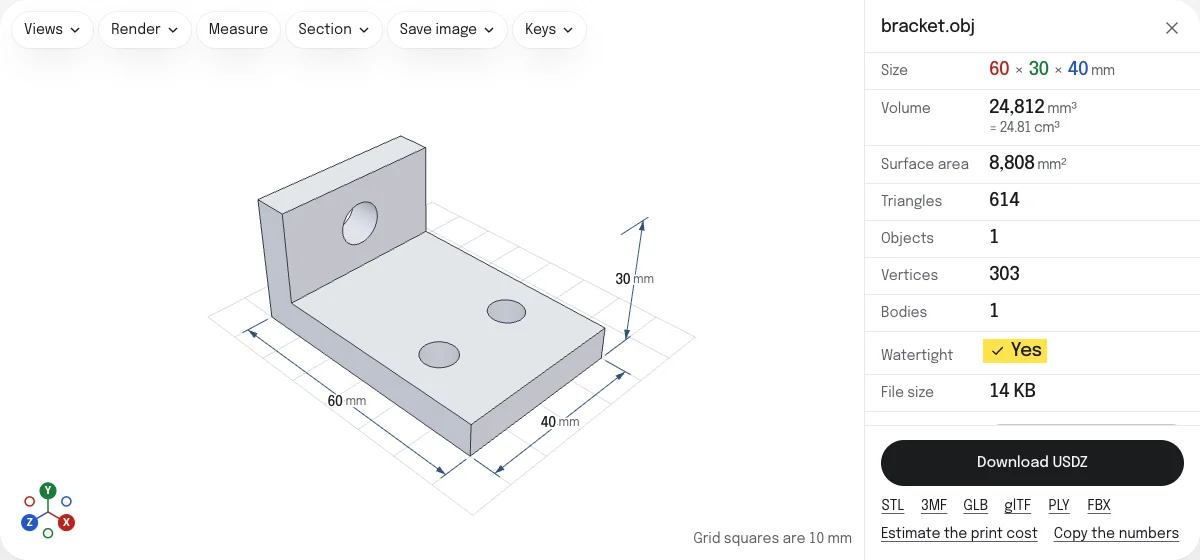
- Drop the OBJ on this page, with its MTL to keep its colors. It is read in your browser; nothing is uploaded.
- Check the size. If the OBJ was drawn in inches or meters, choose that unit under Units: the USDZ is written from it.
- Choose Download USDZ. The file is named after the OBJ:
bracket.objbecomesbracket.usdz.
Which way up
A USDZ stands on Y, as an OBJ usually does. If the model lies on its side, choose the other axis in the Views menu: the USDZ follows what you see.
Several files
Drop several OBJ, STL or PLY files together, or drop more on the open model: each becomes a mesh of its own in the USDZ, named after its file, where it was drawn. Hide any you want left out.
Checked by Apple’s tools and Blender
The USDZ of the sample bracket was checked on November 13, 2026 by Apple’s usdchecker, with its check for AR (--arkit), which it passes. Apple’s SceneKit, which reads USD through Model I/O, and Blender 5.2.3 read it as one mesh of 614 triangles, 60 × 30 × 40 mm with Y up, the bracket standing as it stands on screen. Quick Look itself could not be run: the iOS Simulator’s shows a USDZ as a file to share, not as a model, and a broken one the same way.
How the tools are tested lists every converter’s file and what opened it.
Questions
Is my file uploaded?
No. The OBJ is read and the USDZ is written by your own browser. Nothing is sent to a server.
Why does the USDZ come out the right size?
A USDZ states its unit, and Quick Look places it in AR at that size. An OBJ states none. The converter takes the unit you choose under Units, millimeters to begin with, and writes the USDZ in meters from it: the sample bracket, 60 mm long, stands 6 cm long on a desk in AR.
Are the colors kept?
Drop the MTL with the OBJ: each of its colors becomes a material of the USDZ, up to 32. Without it the model is a light gray. The pictures an MTL names are not carried over: save it as a GLB in the [OBJ viewer](/obj-viewer/) and convert that with [GLB to USDZ](/glb-to-usdz/) to keep them.
How do I see it in AR?
Open the USDZ on an iPhone or iPad: from Files, Mail, Messages or AirDrop, it opens in Quick Look, where AR places it on a floor or a table at its real size.
Is there a limit?
2 million triangles. A USDZ written here holds its scene as text, every number written out, so a million triangles make a file of about 66 MB, which a phone opens slowly.