What the OBJ keeps, and what it loses
| In the OBJ | |
|---|---|
| Shape | Every triangle of every mesh, where the scene places it, as it stands at rest. A mesh placed several times is there each time |
| Names | Each mesh an object of its own, with the name of what places it, numbered when two share one |
| Colors | Each mesh's material color, in a material file beside it. A mesh of several materials is an object for each |
| Size | Millimeters, from the unit the DAE states, or another unit you choose |
| Which way up | Y up |
| Textures | Lost. A GLB keeps them |
| Skeletons and animations | Lost: the model is saved at rest |
| Lights, cameras, lines | Left out |
How to convert a DAE to OBJ
- Drop the DAE on this page, or choose it with the button. Drop its pictures with it to see its textures.
- Look at the model and its size. The panel gives it in meters, from the unit the DAE states.
- Choose the unit of the OBJ under Unit of a saved STL, OBJ or PLY: millimeters for a slicer or a CAD program, meters for Blender.
- Choose Download OBJ. You get a ZIP with the OBJ and its material file, named after the DAE.
A model from SketchUp
SketchUp writes a DAE in inches, standing on Z, and a model of many components places each one as often as it is used. The OBJ has a copy of each where it is placed, so a fence of forty posts has forty posts, each an object.
OBJ, GLB or STL
An OBJ keeps names and colors for another modeling program. For the web, a game engine or AR, a GLB keeps the textures and the animations too: open the DAE in the DAE viewer and save it from there. To 3D print the model, an STL or a 3MF in millimeters, standing on Z, is what a slicer expects.
Checked in assimp
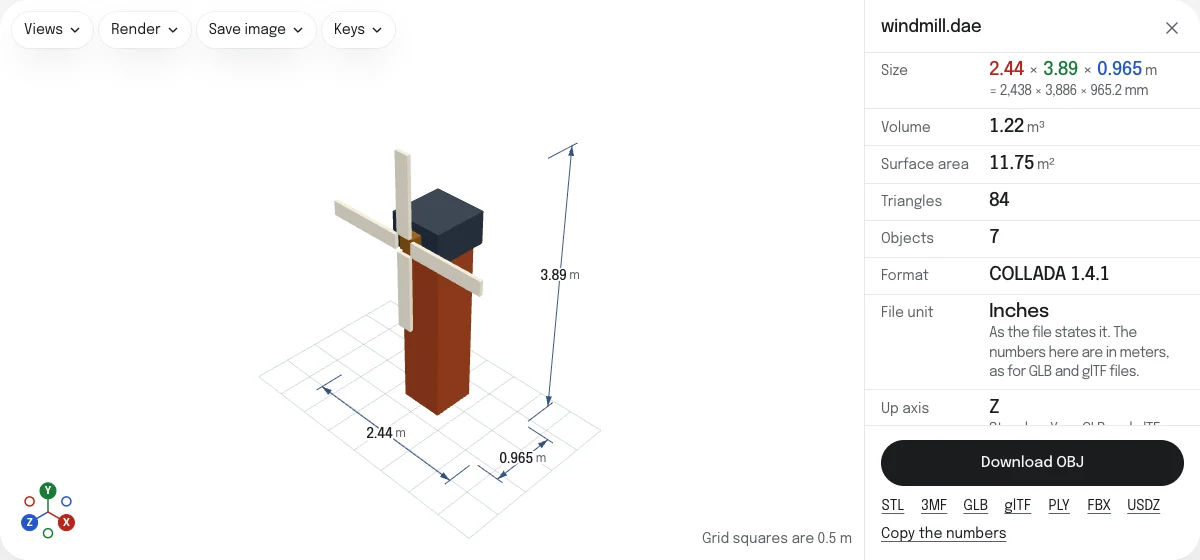
The OBJ of the sample windmill, read by assimp 6.0, an open-source library for reading 3D files, on November 12, 2026: seven objects named Tower, Cap, Hub and Sail_1 to Sail_4, each with its color in the material file, 84 faces, and 2,438.4 × 3,886.2 × 965.2 mm, standing on Y. The DAE is in inches: its 96 inches across the sails arrive as 2,438.4 mm. How the tools are tested lists every converter’s file and what opened it.
Questions
Is my file uploaded?
No. The DAE is read and the OBJ is written by your own browser. Nothing is sent to a server.
Why do I get a ZIP?
An OBJ keeps its colors in a second file, the material file (.mtl), which it names. Every mesh of a DAE has a material, so the two come together, in one ZIP: unzip it and keep the OBJ and the MTL side by side.
Are the textures kept?
No. The OBJ has each material's own color, which for a textured material is often white or gray, and not its pictures or the coordinates that lay them on the surface. To keep the textures, save a GLB.
What unit is the OBJ in?
Millimeters to begin with, which is what slicers and most CAD programs read an OBJ in. Blender reads one unit of an OBJ as a meter: choose Meters under Unit of a saved STL, OBJ or PLY, and the model arrives at its real size there.
Which way up is the OBJ?
Y up, which is the way Blender and most modeling programs read an OBJ. A DAE that stands on Z, as SketchUp's and Blender's do, is stood on Y first, as the viewer shows it.