What it does
- Cut into tiles that fit the bed. Each side of the model longer than the bed is cut into as few equal pieces as fit, along X, Y and Z, with the pins that stand out of them counted when the connectors are pins. Type your bed’s two sides and the height your printer prints to; they start at 256 mm.
- Or where you place the cuts. Each cut is a plane square to X, Y or Z, so far from the model’s lowest point along it. Up to 12, and each piece is checked against the bed.
- Each piece is closed. The cut face is filled, and each piece is checked for holes the way the STL viewer checks a file. Watertight reads Every piece only when each is closed.
- Pins, or holes for dowels. Round or square, 2 to 30 mm wide and 2 to 50 mm deep, with a clearance of 0 to 1 mm on each side. A face long enough gets two, so the pieces cannot turn; one with no room for any is counted.
- Colors kept. Each part of a 3MF is cut on its own and keeps its color, its cut faces too.
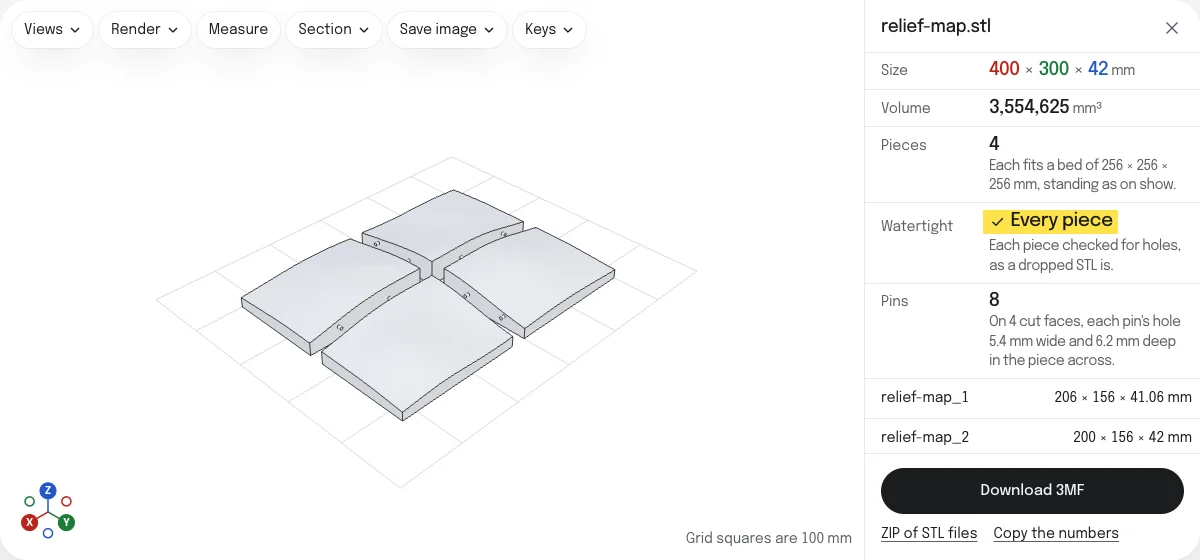
The pieces are drawn apart, so the cut faces and the pins show; untick Draw the pieces apart to see them together. The pieces on show are the ones that are saved.
Where the pins go
A pin goes on a cut face where its hole fits with 1.2 mm of material round it and past its end, three lines of a 0.4 mm nozzle. Two go a quarter in from each end of the face’s longer side when they fit, or one in its middle; a point that has not the room is moved to the nearest point of a grid across the face that has. The hole is checked for what it would break into: the hole, with its wall round it and past its end, must lie wholly in the piece, so a hole that would come out of the far side of a thin piece, or open into a hollow or a slot, is not drilled. On a 3MF, a pin stands wholly on one part, never across the meeting of two. A pin keeps away from the other cuts by its depth, so the holes of two faces of one piece never meet. A face where none fits has no pin, and the Pins row says how many.
A round hole is drawn round its circle, and a round pin inside its own, so the flat sides of each still leave the clearance you chose.
The two downloads
- Download 3MF saves every piece as an object of its own, in millimeters, named after the file and numbered (relief-map_1, relief-map_2), laid apart as they are drawn so no pin sits in a hole. A piece of several colored parts is one object of those parts. The dowels stand in a row beside them. Open it in Bambu Studio, OrcaSlicer or PrusaSlicer, and arrange the pieces over as many plates as they need.
- ZIP of STL files saves each piece as an STL in millimeters, in its place in the model, and the dowels as one more.
Units
STL files hold numbers and no unit. Choose the one the model was drawn in under Units: it is cut and saved in millimeters, as the bed and the pins are given. A 3MF states its unit.
Limits
- Up to 2 million triangles, and up to 64 pieces. Every change cuts the model again, so a larger file is refused: a binary STL from its header, before it is read, a text STL or a 3MF once it is read; Reduce STL file size makes it smaller first.
- The model must be closed. One with holes is shown with them in red, and not cut. STL repair closes those of an STL; a 3MF’s are closed in the program that made it.
- Cuts are flat and square to an axis. A cut at an angle, or along a curve or a dovetail, is not made.
- The pieces stand as the model does. Each is checked against the bed as it stands on show; a slicer can lay one on another side.
- One plate of a 3MF. The printable objects on the plate of its first one are cut together; a note names those left out. A part painted with a brush is cut in its filament’s color.
Checked in PrusaSlicer
The 3MF of the sample relief map as it opens, cut into four tiles with pins, opened in PrusaSlicer 2.9.6 on November 17, 2026: four objects, each one part and manifold, 206 × 156, 200 × 156, 206 × 150 and 200 × 150 mm with the pins that stand out of them, 3,194 facets each. Their volumes add up to the map’s, 3,554,625 mm³, less the clearance round the eight pins. A browser test puts the four STLs of the ZIP back together and finds that no two of them cross. How the tools are tested lists every tool’s file and what opened it.
Questions
Is my file uploaded?
No. The model is read, cut and written again by your own browser. Nothing is sent to a server.
How many pieces will my model be cut into?
Into tiles that fit the bed: each side longer than the bed is cut into as few equal pieces as fit, with the pins standing out of them. A model 400 × 300 mm on a bed of 256 × 256 mm is four tiles of 200 × 150 mm. Type your printer's bed and the height it prints to under Bed X, Bed Y and Bed height, and the tiles follow. Up to 64 pieces.
Can I choose where the cuts go?
Yes. Choose Where I place the cuts under Cut, then give each cut its axis and how far it is from the model's lowest point along that axis. Add up to 12. Each piece is then checked against the bed, and one that is larger is named in red.
What clearance should the pins have?
The page starts at 0.2 mm on each side, a push fit on most FDM printers: a 5 mm pin goes into a hole 5.4 mm wide and its depth plus 0.2 mm deep. For a looser fit, or a printer that prints holes small, raise it to 0.3 or 0.4 mm. Print one pair of pieces first to try it.
Pins or dowels?
A pin is printed on one piece and goes into a hole in the other, so there is nothing else to print. It stands out of its face, so lay that piece with the pin pointing up, or print it with supports. Dowels are printed apart, standing, which makes them stronger, and every cut face is flat with a hole in it. Either way the pieces cannot turn: a face long enough gets two.
Why does a cut face have no pin?
A pin is placed only where its hole has 1.2 mm of material round it and past its end, and keeps away from the other cuts so that holes from two faces never meet. A face too thin or too small for that has none, and the page counts it. Make the pins smaller, or glue that face.
Does it keep the colors of my 3MF?
Yes, each part's own. Each part of the 3MF is cut on its own, so a cut face takes the color of the part it crosses, and each piece is an object whose parts keep their colors. A part painted with a brush, or one whose triangles have several colors, is cut in one color or none, and a note says so.
My model is not watertight. Can it still be cut?
Not here. A cut closes each piece over the cut, which only a closed solid has an inside for. The page shows the open edges in red and says what to do: for an STL of up to 5 million triangles it offers STL repair, which closes most holes, and you cut the repaired file. A 3MF's holes are closed in the slicer or CAD program that made it.